 |
 |
 |
 |
 |
 |
 |
 |
 |
 |
 |
 |
||||||||
 |
Resources The day after doing stretching exercises, I see less, my eyes are stiff. What to do? FAQ n. 41. Power Vision System - I’m twenty-three and I gave up wearing my glasses when I was eighteen, looking to improve my sight. At that time, my diopter (I was a myope) was just 1 D per each eye with a low astigmatism in my left eye. I’m in a much worse situation today! I can hardly go around without my glasses, though I haven’t worn them for over five years. The last time I went to the ophthalmologist, I had –2.25 in my right eye and –1.75 in the left one. It’s surely much worse today. I discovered your method, and ever since then I’ve realized that my sight is getting worse and worse. The first three years without wearing my glasses I was able to keep my myopia almost shifting whenever I could, and, despite everything, my myopia was low. Now I go to the university and follow your advice. I always study holding the text as far as I can, even though I must read more slowly; I do ocular stretching in front of mirror every second day, and I do my best to view distant whenever I can. I never put my glasses on, only my contact lenses (undercorrection), and only when I play football (three or four times a week).
I gave up doing the exercises of defocus with positive lenses +1.00 because my sight wasn’t clear the day after doing them. Last year, as soon as I took off my +1.00 glasses I had some clear “pulling,”but not anymore. Now I only do defocus without positive lenses, but the result is that my eyes are even more stiff.
Could this theory of mine be true, that my eyes are getting used to sighting everything and are always blurred? Defocus stimulus doesn’t do anything but make me get used to the blur even more. Since I’m a student I study a lot, even if at the furthest possible distance. Could you suggest an optimal program, perhaps one exercise, even if it is difficult and takes a long time to do? (I can find an hour or two a day.) 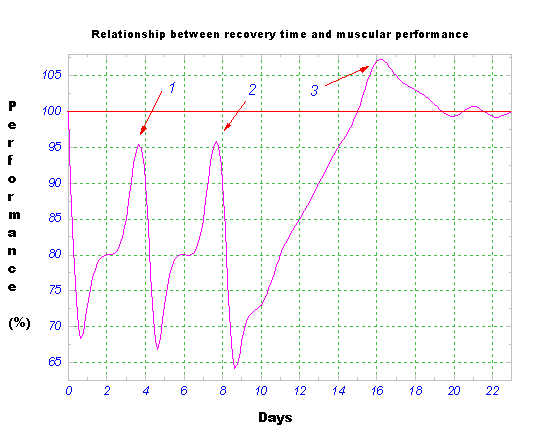 - Answers David De Angelis
 Figure Q.1 shows the relationship between recovery time and muscular performance quality increase—in this case muscular strength increase. After being trained, a muscle suffers from physiological performance drop, and later on, with time, it overcomes its initial performance limits (strength increase).
So, train but don’t forget that any increase in muscular capabilities (even focusing) also depends on the right recovery time and not only on factor of training itself.
If recovery time is long enough, you can obtain the necessary adaptation (point 3 in Figure Q.1 in the case of ocular muscles). If recovery time between training sessions of ocular stretching isn’t long enough, the result will be a transient and physiological worsening of saccadic vibration and focusing. Back |
||||


 |
 |
| www.powervisionsystem.com | Created by Aser srl |